International standards you can trust at a glance.
ISO 9001
Quality
A management system focused on continuous improvement and customer satisfaction.
IATF 16949:2016
Automotive
Quality requirements specific to the automotive industry.
ISO 14001
Environment
Control of environmental impacts and regulatory compliance.
ISO 50001
Energy
Energy performance driven by measurable objectives.
ISO 45001
Health & Safety
Risk prevention and continuous improvement of working conditions.
Inspection & Testing
Control of Internal and External Integrity
Inspection and testing are central to ensuring the quality of steel products. They enable the assessment of internal integrity, surface quality, and dimensional compliance throughout the entire industrial process — from material transformation to final delivery.
Fully integrated into the production chain, these controls ensure product reliability and compliance with the standards and requirements of demanding industrial sectors.
Internal Integrity Testing by Ultrasonic Inspection
Ultrasonic testing is used to assess the internal integrity of steel products without altering their properties. It is an essential tool for detecting internal discontinuities and verifying material consistency.
Ultrasonic inspections are performed according to controlled procedures, adapted to long bars and large cross-sections, and compliant with applicable standards. They ensure mechanical performance and product reliability in service.
Surface Defect Inspection by Eddy Current Testing
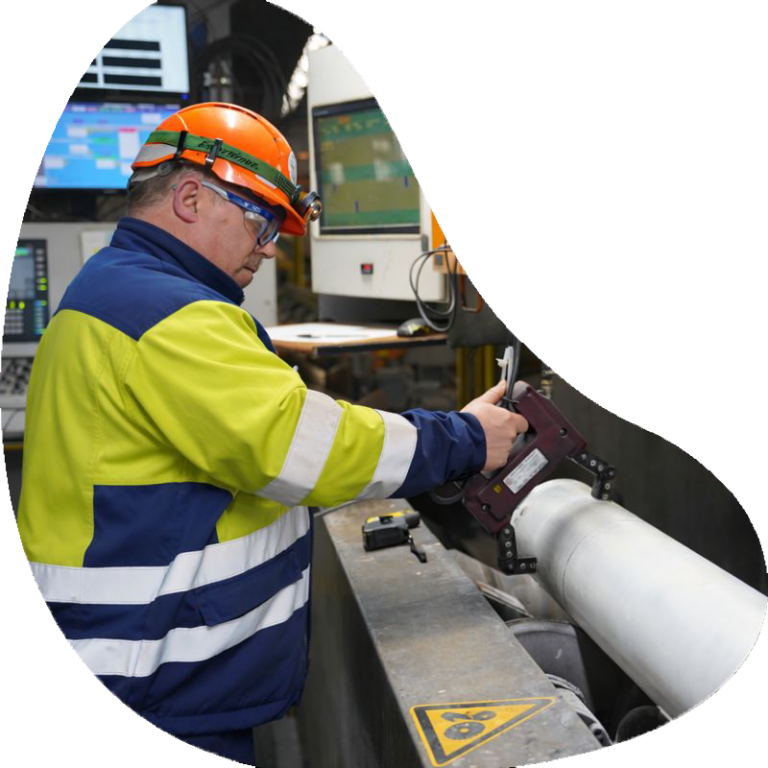
Eddy current testing is used to quickly and accurately detect surface defects such as cracks, laps, and other discontinuities. It provides reliable and repeatable inspection, even for complex parts or high-volume production.
Thanks to its high sensitivity to surface and near-surface defects, eddy current testing ensures optimal quality.
Surface Quality Inspection and Associated Controls
Surface quality is carefully monitored to ensure the absence of defects that could affect performance or downstream operations. These inspections are carried out through visual checks and eddy current testing, in line with industrial requirements.
Dimensional & Geometrical Inspection
Dimensional inspections verify compliance with lengths, diameters, tolerances, and geometries of steel products. They are carried out after rolling, peeling, cutting, or machining operations.
They also ensure production repeatability, dimensional consistency, and compliance with customer specifications.